
14/08/2026 07:38 pm MYT
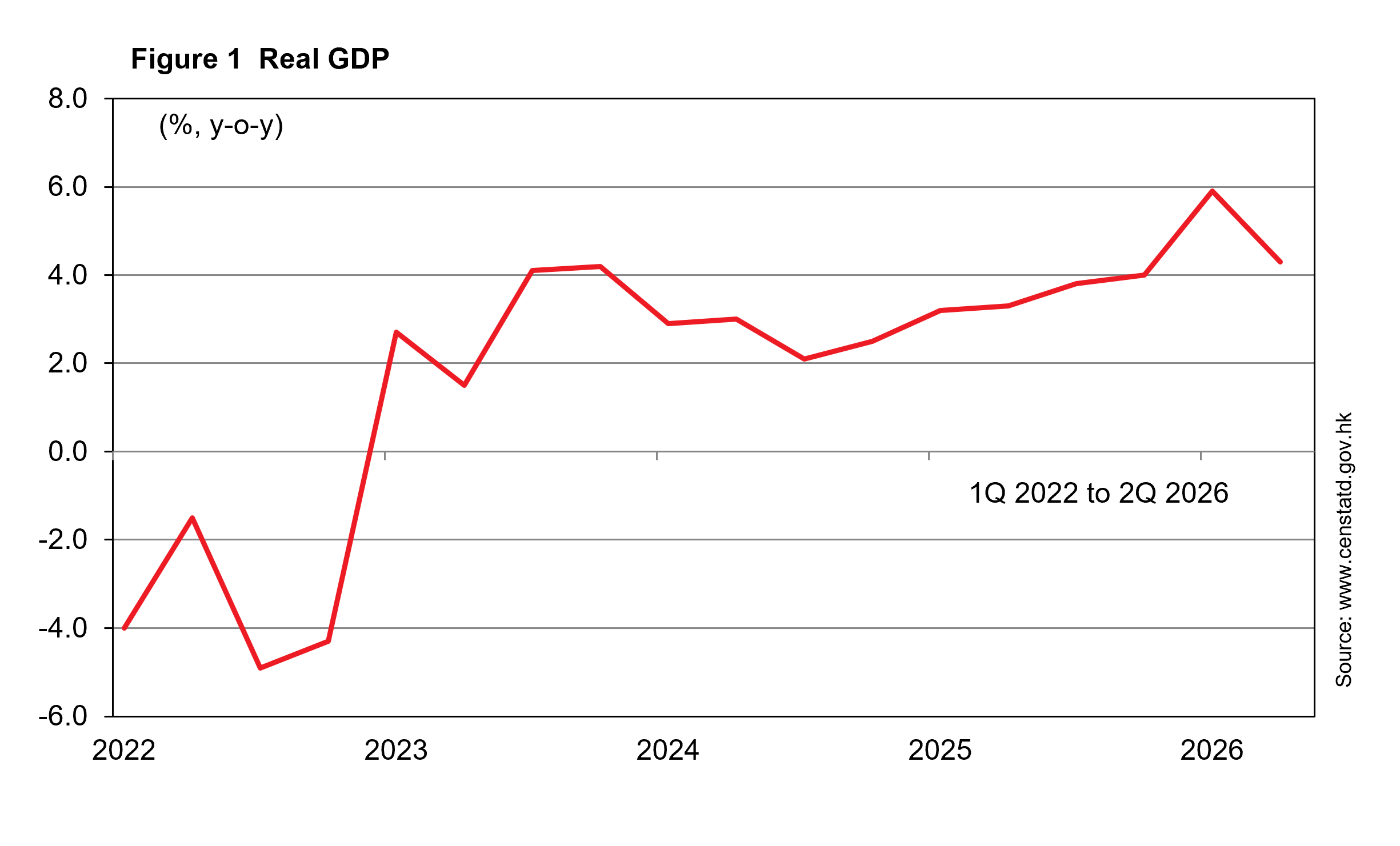
Unchanged from the advance estimates, Hong Kong's real GDP increased by 4.3% year-on-year in 2Q 2026, down from the robust growth of 5.9% in the previous quarter (figure 1). On a seasonally adjusted basis, real GDP decreased by 0.6% quarter-on-quarter in 2Q 2026.
Most of the expenditure components recorded slower growth. Private consumption increased by 2.9%, while government consumption was broadly unchanged in 2Q 2026. Meanwhile, gross domestic fixed capital formation increased by 4.6% year-on-year (table 1), mainly due to a slowdown in public sector expenditure on building and construction.
Exports and imports of goods increased by 28.9% and 29.3%, respectively, from a year ago. Meanwhile, exports and imports of services increased by 3.4% and 3.0%, respectively. Exports of goods were mainly supported by strong demand for AI-related electronic products, while exports of all major service groups continued to expand.

Looking ahead, Hong Kong's economic growth will continue to be supported by exports of AI-related products, sustained visitor growth and strong domestic demand, amid ongoing geopolitical tensions.
Note from Publisher
This week, economy minister Akmal Nasrullah Mohd Nasir announced that the federal government will allocate RM12.3 mln over four years for a science, technology, engineering and mathematics (STEM) talent development programme in Penang, with the aim of reaching 100,000 students by 2030. The programme is designed to expose students to STEM from an early age, helping to nurture interest and build the skills required for the industries of the future. Penang was chosen as the pilot location because its well-established industrial ecosystem provides an ideal environment to test and refine a model that could subsequently be replicated across the country.
This is precisely the kind of long-term investment in human capital that Malaysia needs to support the National Semiconductor Strategy (NSS). Malaysia needs to build a deep and sustainable pool of engineers, scientists, technicians and other highly skilled workers capable of supporting the industry's continued upgrading.
The Penang pilot is therefore more than just a STEM education programme. It is an investment in the human capital required for Malaysia's next phase of industrialisation. More programmes of this nature, sustained over many years and expanded nationwide, will be essential if Malaysia is to move up the semiconductor value chain and realise the ambitions of the NSS.
PORTFOLIOS









In The Media

STOCK SELECTIONS
KLSE | 5 hours, 29 minutes ago
NASDAQ Stockholm | 4 days, 16 hours ago
KLSE | 1 week ago
SSE | 1 week, 4 days ago
KLSE | 2 weeks ago
Corporate News