
24/06/2026 05:18 pm MYT
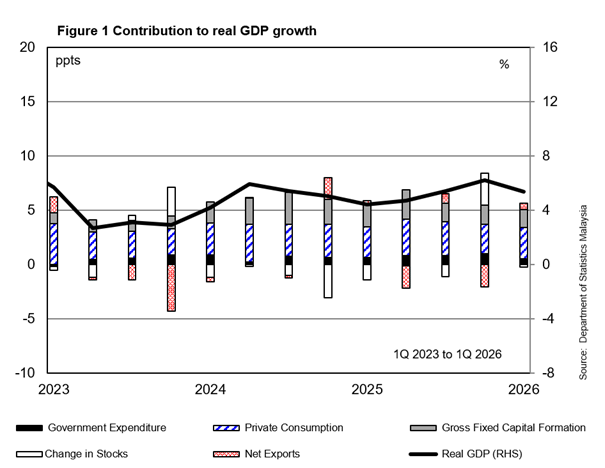
In 1Q 2026, Malaysia's real GDP grew by 5.4% year-on-year (figure 1), down from a 6.2% growth in the previous quarter.
Supply Conditions |
Apart from the mining & quarrying sectors, all other economic sectors grew in 1Q 2026 (table 1).
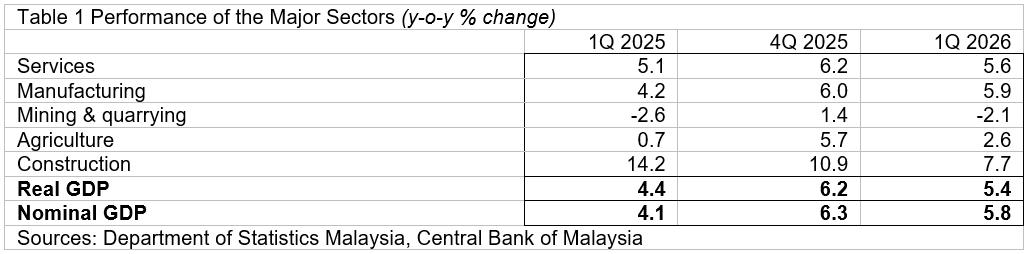
Services, the largest economic sector, which accounts for 59.9% of the GDP, increased by 5.6% year-on-year in 1Q 2026. Growth was underpinned by increases across all sub-sectors, especially wholesale & retail trade (4.8%), information & communication (8.1%) and transportation & storage (8.5%) sub-sectors.
Manufacturing, the second-largest economic sector (23.1% of GDP), grew by 5.9% year-on-year in 1Q 2026. This was mainly attributed to growth in the electrical, electronic & optical products (12.8%), vegetable and animal oils & fats and food processing (9.2%) and non-metallic mineral products, basic metal & fabricated metal products (5.0%) sub-sectors.
The construction sector, which accounts for 4.4% of the GDP, expanded by 7.7% year-on-year in 1Q 2026. The strong performance was primarily due to growth in specialised construction activities (15.9%), followed by non-residential buildings (10.1%).
The agriculture sector, which accounts for 5.6% of the economy, increased by 2.6% in 1Q 2026. This was mainly due to increases in the oil palm (5.5%), livestock (8.7%) and other agriculture (1.5%) sub-sectors.
The mining & quarrying sector, which accounts for 5.7% of the GDP, declined by 2.1% in 1Q 2026. This was mainly due to decreases in crude oil & condensate production and natural gas segments by 4.2% and 2.1%, respectively.
Demand Conditions |
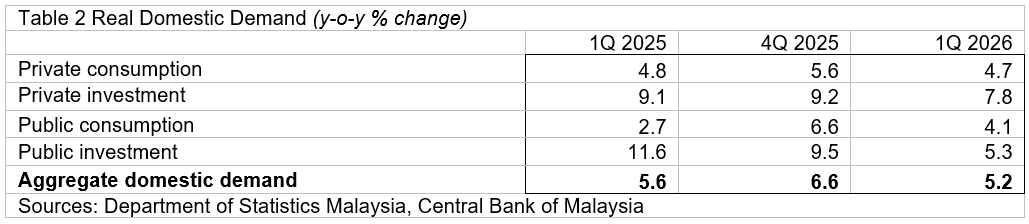
In 1Q 2026, domestic demand grew by 5.2% year-on-year, down by 1.4 percentage points from the growth rate in the preceding quarter (table 2).
Private consumption grew by 4.7%, while public consumption rose by 4.1% year-on-year in 1Q 2026.
Meanwhile, gross fixed capital formation increased by 7.3% year-on-year in 1Q 2026, with private and public sector investment growing by 7.8% and 5.3%, respectively. The expansion in gross fixed capital formation was supported by solid investment in machinery & equipment, structures and other assets.
External Trade |
In 1Q 2026, the trade surplus rose by 54.0% year-on-year to RM63.2 bln. Exports grew by 12.7% year-on-year, while imports increased by 7.7% year-on-year.
Public Finance |
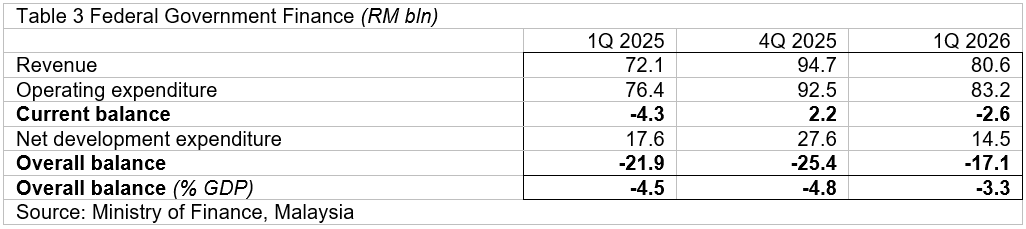
The federal government's fiscal deficit narrowed to 3.3% of GDP in 1Q 2026, down from 4.8% in 4Q 2025 (table 3).
External Debt |
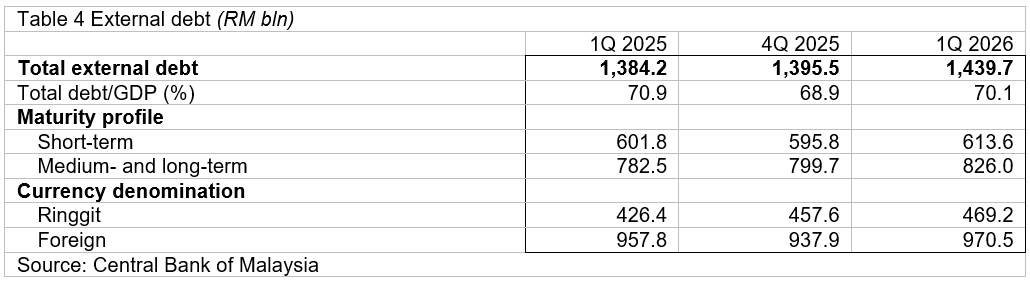
External debt amounted to RM1,439.7 bln, or 70.1% of GDP as at the end of 1Q 2026 (table 4). Ringgit-denominated debt accounted for 32.6% of total external debt, while the remaining 67.4% was denominated in foreign currency.
Inflation |
In 1Q 2026, the headline inflation rate edged higher to 1.6%, while the core inflation rate decreased to 2.1%. The rise in headline inflation was driven by higher prices for electricity and fuel due to global supply pressures from the conflict in the Middle East.
Money Supply |
At the end of 1Q 2026, the annual growth rate of the broad money supply (M3) was 5.5%, up by 1.4 percentage points from the growth rate at the end of 4Q 2025. Growth in bank lending increased to 5.4% at the end of 1Q 2026 from 4.8% at the end of 4Q 2025.
Interest Rates |
The overnight policy rate remained at 2.75% in Mar 2026. As at end Mar 2026, the average base lending rate, 1-month fixed deposit rate, and 12-month fixed deposit rate of commercial banks stood at 6.43%, 1.84%, and 2.10%, respectively.
Comments |
Malaysia's economy in 1Q 2026 was supported by strong private consumption, underpinned by favourable labour market conditions, despite headwinds from elevated oil prices amid the Middle East conflict (figure 1).
Malaysia's economic growth in 2026 is expected to be moderate, supported by strong domestic demand, a favourable labour market, and resilient exports, particularly in the electrical and electronic sectors. Growth will be further lifted by strong realisation of approved investments under the 13th Malaysia Plan and robust inbound tourism from the Visit Malaysia 2026 campaign. However, risks from weaker commodity production, higher cost of living, slower global trade, and a prolonged Middle East conflict may weigh on growth momentum.
i Capital projects Malaysia's real GDP to grow in the range of 5.0% to 5.5% in 2Q 2026, with full year growth forecast at 4.0% to 5.0%.
Note from Publisher
According to the Department of Statistics Malaysia, Malaysian households discard between 31.9 kg and 97.3 kg of food per person annually, with the majority of waste coming not from scarcity but from daily behaviour and management practices. Processed and cooked food is more frequently discarded than raw ingredients, with rice, vegetables, and takeaway meals forming a large share of what ends up in the bin. This points to inefficiencies in meal planning, over-preparation, and the common habit of storing food beyond their usable life.
In addition, nearly 80% of Malaysian households did not practise separate disposal, throwing away food waste together with other household trash, limiting recycling or composting potential and adding pressure to already strained landfills.
Although the estimated range of Malaysia’s household food waste per capita is broadly in line with the global average of 79 kg, it should not be taken lightly. Food waste has implications on food security, resource efficiency, societal well-being, and environmental sustainability. We need to have serious public awareness campaigns about meal planning, purchasing planning, and proper disposals. Malaysians should not take having abundant food for granted.
PORTFOLIOS









In The Media





STOCK SELECTIONS
SZSE | 1 week, 2 days ago
KLSE | 1 week, 4 days ago
SZSE | 2 weeks, 2 days ago
KLSE | 2 weeks, 4 days ago
SSE | 3 weeks, 2 days ago
UNIVERSAL SCIENTIFIC INDUSTRIAL (SHANGHAI) CO LTD (USI, 601231)
Corporate News
2Q Results
Successful joint tender
Wins hospital LLM deals
Strategic partnership
Wet lease agreement